Field visit on paddy fields of ICARIAR- crop diversity
Field visit on paddy fields of ICARIAR- crop diversity
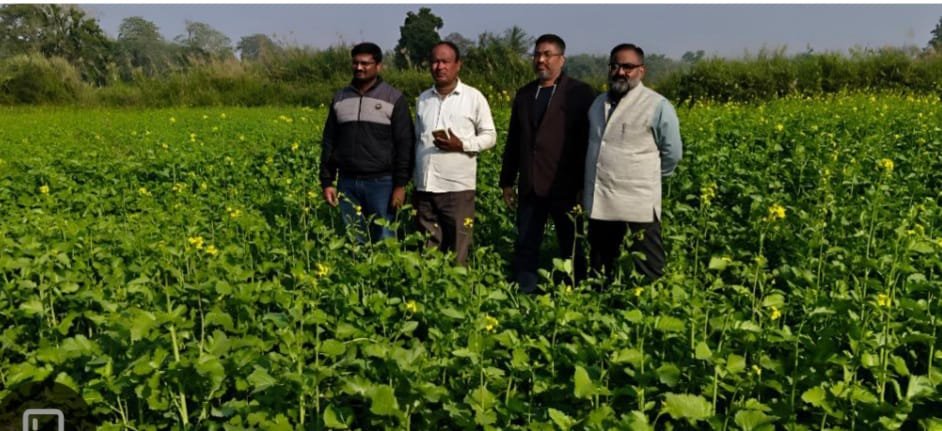
DD TIMES Gogamukh, 8 January: ICAR-Indian Institute of Agricultural Research (IARI), Assam under the overall supervision and guidance of the Director of the Institute, ICAR-Indian Institute of Agricultural Research (IARI) actively participated in crop diversification and intensification techniques in paddy field ecosystems on 6th January.
The overall objective is to develop scientifically designed cropping systems to increase profitable production, resource use efficiency, and sustainability in agriculture.
The programme was planned, executed, and monitored by a team of Natural Resource Management (NRM) scientists, led by Dr. Lohit Kumar Baishya, Head, NRM Division, and supported by Dr. Rahul Singh, Senior Scientist (Agricultural Extension); Dr. Arpan Bhownik, Senior Scientist (Agricultural Statistics); and Dr. Chethan C. R., Senior Scientist (Farm Machinery and Power Engineering). The collective expertise of the NRM team ensured an integrated. systems-oriented, and field-responsive approach to crop diversification in rice fallow areas.
Under a farmer-participatory programme covering 30 hectares in Dhemaji district, the Institute introduced a basket of short- and medium-duration rice varieties CR-307, CR-310, CR-311, CR-801, CR-802, and CR-901-carefully selected to suit the region’s agro-ecological conditions and climatic constraints.
The on-farm participatory trials produced highly encouraging results, with the improved rice varieties recording an average productivity of 5.2 t hat. The timely maturity of these varieties proved critical in enabling efficient crop sequencing and creating a viable window for rabi crop introduction. Building on this success, mustard variety PM-25 was introduced immediately after rice harvest by effectively utilizing residual soil moisture, supported by appropriate soil and water management practices thereby addressing the long-standing practice of keeping rice fields fallow during the rabi season.
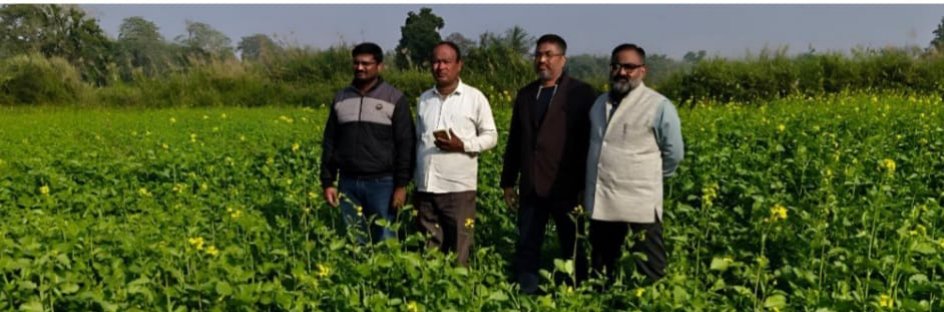
Scientists from the NRM Division closely monitored the mustard crop under rice fallow conditions and documented a mean yield of 2.0 t ha¹, clearly demonstrating the technical feasibility and economic attractiveness of the rice-mustard cropping sequence. Farmers expressed strong satisfaction with the performance of both crops, highlighting improved land use efficiency. enhanced income generation, and reduced production risks.
Encouraged by these outcomes, participating farmers further proposed the inclusion of summer moong following mustard harvest, envisioning the evolution of the system into a rice-mustard-moong sequence.
Such system intensification is expected to substantially enhance overall system productivity, profitability, soil health, and long-term sustainability, while also contributing to pulse self-sufficiency and climate-resilient agriculture in the flood-prone regions of Assam.
Overall, the Field Day reaffirmed the transformative potential of varietal diversification and strategic crop sequencing in rice fallow lands, offering a replicable and scalable model for improving the livelihoods of small and marginal farmers through science-led, NRM-driven, and participatory extension interventions.
The programme was planned, executed, and monitored by a team of Natural Resource Management (NRM) scientists, led by Dr. Lohit Kumar Baishya, Head, NRM Division, and supported by Dr. Rahul Singh, Senior Scientist (Agricultural Extension); Dr. Arpan Bhownik, Senior Scientist (Agricultural Statistics); and Dr. Chethan C. R., Senior Scientist (Farm Machinery and Power Engineering).
The collective expertise of the NRM team ensured an integrated. systems-oriented, and field-responsive approach to crop diversification in rice fallow areas.
Under a farmer-participatory programme covering 30 hectares in Dhemaji district, the Institute introduced a basket of short- and medium-duration rice varieties CR-307, CR-310, CR-311, CR-801, CR-802, and CR-901-carefully selected to suit the region’s agro-ecological conditions and climatic constraints.
The on-farm participatory trials produced highly encouraging results, with the improved rice varieties recording an average productivity of 5.2 t hat. The timely maturity of these varieties proved critical in enabling efficient crop sequencing and creating a viable window for rabi crop introduction. Building on this success, mustard variety PM-25 was introduced immediately after rice harvest by effectively utilizing residual soil moisture, supported by appropriate soil and water management practices thereby addressing the long-standing practice of keeping rice fields fallow during the rabi season.
Scientists from the NRM Division closely monitored the mustard crop under rice fallow conditions and documented a mean yield of 2.0 t ha¹, clearly demonstrating the technical feasibility and economic attractiveness of the rice-mustard cropping sequence. Farmers expressed strong satisfaction with the performance of both crops, highlighting improved land use efficiency. enhanced income generation, and reduced production risks.
Encouraged by these outcomes, participating farmers further proposed the inclusion of summer moong following mustard harvest, envisioning the evolution of the system into a rice-mustard-moong sequence. Such system intensification is expected to substantially enhance overall system productivity, profitability, soil health, and long-term sustainability, while also contributing to pulse self-sufficiency and climate-resilient agriculture in the flood-prone regions of Assam.
Overall, the Field Day reaffirmed the transformative potential of varietal diversification and strategic crop sequencing in rice fallow lands, offering a replicable and scalable model for improving the livelihoods of small and marginal farmers through science-led, NRM-driven, and participatory extension interventions.